
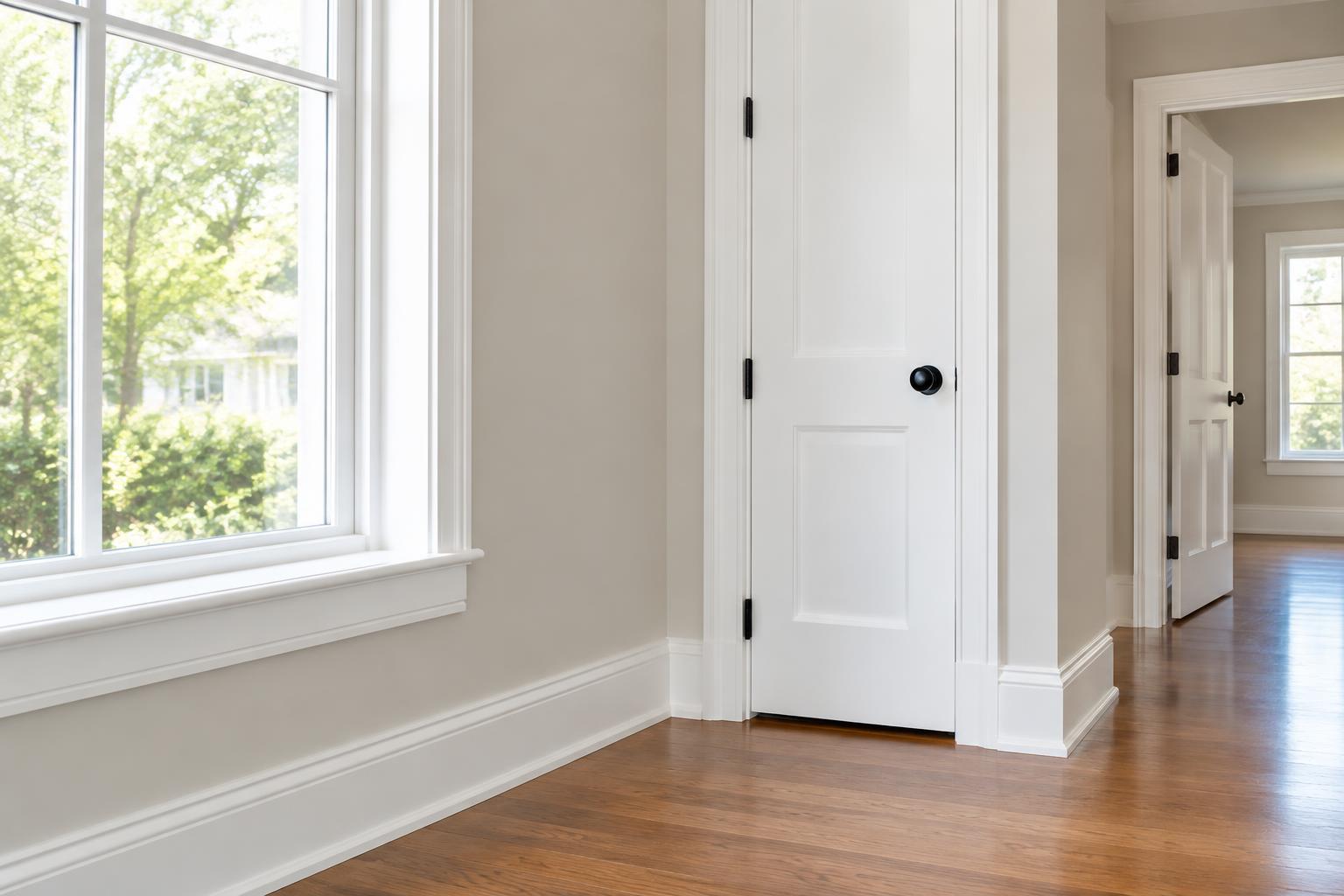
Trim and doors take longer per square foot than walls because most of the work is preparation. Cleaning, sanding, filling, caulking and masking usually take more hours than the painting itself, and each coat has to dry before the next. A room with baseboards, casing, window trim and two doors is four separate jobs.
Why does trim take so long when there's so little of it?
Homeowners look at a room and see hundreds of square feet of wall and maybe forty feet of baseboard, and reasonably assume the baseboard is the quick part. It usually isn't. Walls are wide open surfaces you can roll in long passes. Trim is narrow, it meets other finished surfaces on both edges, and every one of those edges has to be either cut by hand or masked off.
On most trim work, the brush time is the smallest part of the day. The hours go into cleaning, sanding dull, filling nail holes and dings, caulking gaps where the casing meets the wall, and taping and papering the floor so nothing lands where it shouldn't. Careful surface preparation is how we've worked since 1989, and it's the part that decides whether the finish still looks sharp in five years.
Then there's drying. Trim enamel needs real time between coats, and most trim needs two coats to look right. That's not time we can compress by adding people to the job.
Baseboards, casing, window trim and doors are four different jobs
When someone asks for a trim quote, they're usually picturing baseboards. The scope we're actually looking at is baseboards and casing, interior doors and window trim, and each one works differently.
Baseboard means working low, masking the floor or carpet edge, and dealing with whatever the vacuum and furniture have done to it over the years. Door and window casing is at eye level, so flaws show more and the cut lines against the wall have to be clean. Window trim often includes sills and stools that take abuse from sun and condensation. Doors are their own animal entirely.
That's why a room with a lot of openings costs more than a room of the same size with one door and one window. We count linear feet of trim and we count doors, not just floor area.
What happens with stained or glossy woodwork?
Painting stained or varnished trim is something we do often, but we inspect the existing finish before we quote it. A slick, glossy or waxed surface won't hold paint on its own. It needs to be cleaned, scuff sanded and primed with a product chosen for that surface before any finish coat goes on.
That extra step is real time and real material, and it's the most common reason a trim quote comes in higher than a homeowner expected. It's also the step you can't skip. Paint that goes over an unprepared glossy finish will chip off a baseboard corner or a door edge within a season.
If your woodwork is already painted and in sound condition, the prep is lighter — clean, sand dull, fill and caulk. We'll tell you which situation you have when we look at it.
Do doors come off the hinges?
It depends on the door and the finish you want. Painting a door in place is faster and keeps the room usable, and for a standard flat or panel door in good shape it gives a clean result. Taking a door down, pulling the hardware, and laying it flat gives the smoothest finish and lets us get the top and bottom edges, but it means the opening is unusable while the door dries.
Either way, hardware is a decision. Knobs, latches, hinges and strike plates either come off or get masked. Removing them takes longer up front and looks better afterward. Masking is quicker but has to be done tightly or you see it.
The part people underestimate is the drying. A freshly painted door can feel dry to the touch and still stick to the jamb if you close it too early. We'll tell you how long to leave each door standing open before it gets latched, and it's longer than most people assume.
Should trim be a different sheen than the walls?
Almost always, yes. Trim and doors get touched, kicked, cleaned and bumped, so they take a harder, more washable finish than a wall does. The higher sheen also gives the trim a visual edge against the wall color, which is most of what makes a room look finished.
How far you go up the sheen scale is a judgment call based on how smooth the woodwork is — shinier finishes show every ripple and old fill. We walk through this on the job, and if you want the longer explanation first, read our guide to paint sheen for walls, ceilings and trim.
Color matters less than people think. A trim white that looks right next to one wall color can look dingy next to another, so we look at them together rather than choosing the trim in isolation.
Is it better to do trim with a full repaint or on its own?
Doing trim at the same time as walls and ceilings is usually the better value. The room is already covered and masked, the furniture is already moved, and we're already set up. Adding trim to an interior painting scope costs less than bringing a crew back for trim alone later.
It also looks better. New wall paint next to old trim tends to make the trim look worse than it did before, because the fresh color shows every yellowed or chipped spot beside it.
Standalone trim work still makes sense in two cases: the walls are in good shape and a recent color you like, or you're painting stained woodwork and that alone will change the room. Both are jobs we take on their own — see the trim and doors service page for what's included.
What drives the price of a trim and door estimate?
Six things, mostly. Linear feet of trim. Number of doors, and whether they're flat, panel or louvered. The condition and type of the existing finish — painted and sound, or stained and glossy. How many colors are involved. Access, meaning stairwells, high windows and tight rooms. And the products specified, which are confirmed in the written estimate.
We don't quote trim by square footage of floor, because two rooms the same size can be an hour apart or a day apart depending on those factors. Every project is quoted on site after we've looked at the actual woodwork.
Right now we're running 25% off interior painting through the end of the year, which applies to interior trim and door work. Call (775) 450-5012 or use the quote form and we'll come look.
What do we move, and what should you clear?
We move and cover furniture, mask floors and carpet edges along the baseboard, and protect door hardware or remove it. Cleanup at the end of each day is part of the job, not something we leave for the finish.
What helps most is if you clear the small things off low surfaces and out of closets along the walls we're working, and let us know ahead of time about pets and doors that need to stay functional overnight. If a bedroom door has to close that night, we'll schedule it differently.
Our full prep checklist is in our post on how to prepare your home for interior painters.
Frequently asked questions
Can you paint trim that's currently stained wood?
Yes, we do it often. We inspect the existing finish first, because stained or glossy surfaces usually need extra preparation — cleaning, scuff sanding and a primer suited to that surface — before the finish coats go on. That extra prep is included in the estimate so there are no surprises.
How long before I can close a freshly painted door?
Longer than it feels like. The surface can be dry to the touch well before the film has hardened enough to not stick to the jamb or the stop. We'll give you a specific window for the doors on your job and we'd rather you leave them propped open an extra night than risk pulling paint off the edge.
Can you match the existing trim white in the rest of my house?
Usually. Older trim yellows and chalks over time, so a lab match of an aged surface often reads differently than the original color did. We'll look at it next to a fresh sample and talk through whether matching the aged tone or repainting more of the house gives the result you want.
Do you paint exterior doors and trim too?
Yes. Exterior doors, trim and accents are part of our exterior painting work, with coatings chosen for Northern Nevada sun, wind and temperature swings. The prep is different outdoors and the weather window matters, so we schedule those separately from interior work.
How many days should I expect for trim in a typical room?
It depends on the trim count, the condition of the existing finish, and how many coats the surface needs with drying time between them. We give you a day count with the written estimate once we've seen the room rather than guessing from square footage.