
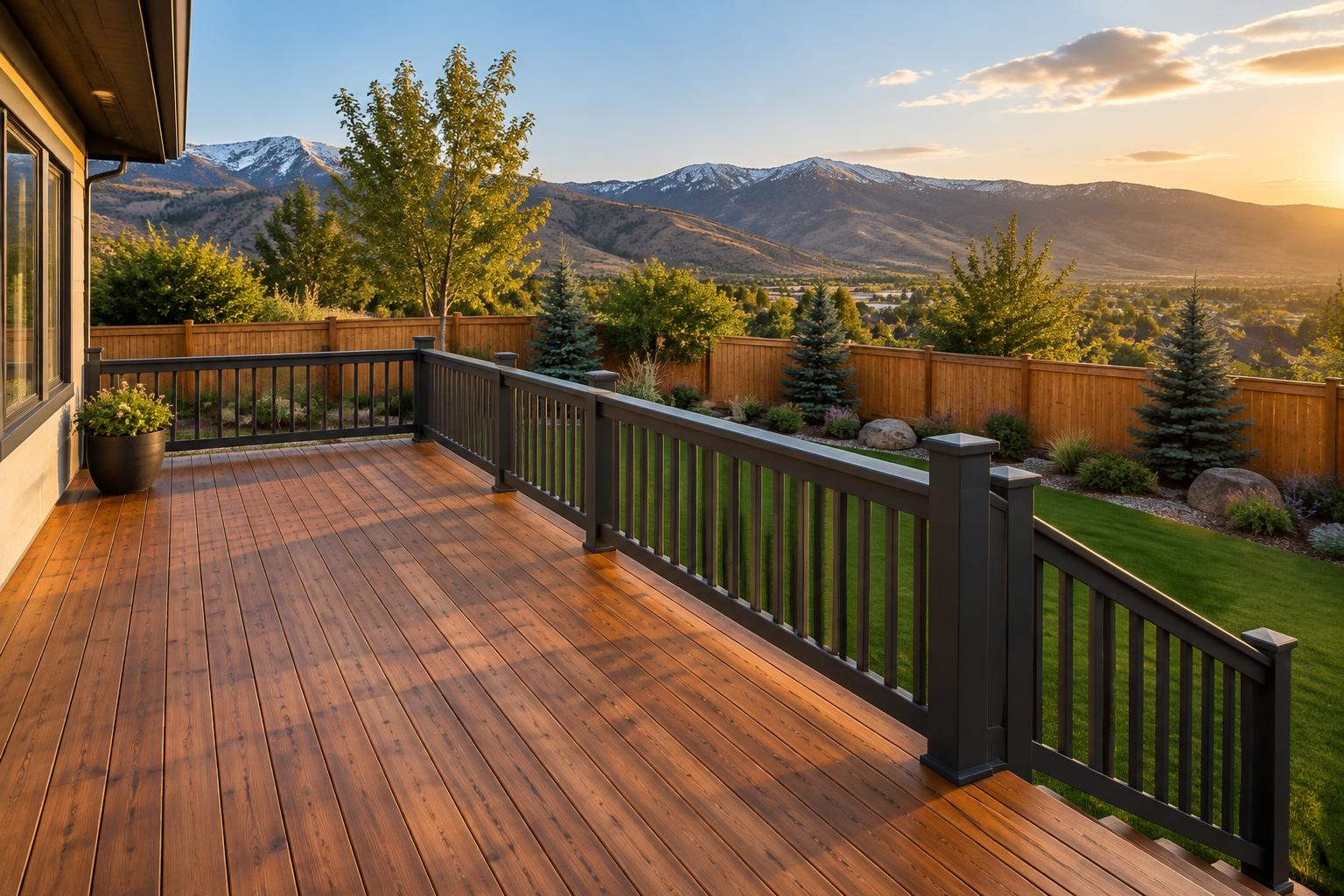
On a sun-exposed Northern Nevada deck, what is already on the wood usually decides for you. Bare or previously stained wood takes stain well and wears by fading rather than peeling. A deck already carrying a paint film is rarely a good stain candidate, because every trace of that film has to come off first.
Why the existing coating decides this before your preference does
Most homeowners start this conversation with a look in mind. That matters, but it is the second question. The first is what is on the boards right now, and how well it is holding.
Stain soaks into the wood. Paint sits on top of it as a film. You can put paint over stain fairly easily once the surface is clean and dull. Going the other direction is much harder, because stain cannot penetrate wood that is sealed under a coating. Any paint left in the grain shows as a patch forever.
So when someone asks whether to stain or paint, we look at the deck first. Bare wood, weathered wood or an old penetrating stain gives you both options. Old paint usually narrows it to one, unless you are willing to pay for full removal.
How stain behaves on a deck that gets full sun
High sun and dry air are hard on wood finishes, and they are hard on stain in a specific way: it fades. The pigment that blocks UV slowly gives up, color goes flat and gray, and the surface starts drinking water again instead of shedding it.
The upside is how it fails. Stain thins out rather than lifting, so you usually do not get sheets of peeling to scrape. When it is time, a clean, a light sand where needed and a recoat puts it back. Maintenance is more frequent but simpler, and the deck never reaches a point where it looks half-destroyed.
Solid-body stains hold color longer than semi-transparent because they carry more pigment, at the cost of hiding the grain. Semi-transparent shows the wood and needs attention sooner. Which one we recommend depends on how much sun that particular deck takes and how often you want to think about it.
How paint behaves, and why it is harder to reverse
Paint builds a film over the boards. That film is the strongest barrier of the two options, holds color the longest, and hides wood that has already been patched or is mismatched. On railings, posts and trim it can look sharp for years.
The problem is the walking surface. Horizontal boards hold sun, standing water and snowmelt, and foot traffic drives grit into the film. When the film fails on a deck floor it fails at the edges — board ends, screw heads, checks in the grain — and lifts. Once lifting starts, the fix is scraping and sanding, not just another coat.
Paint is also a one-way decision for practical purposes. Plan on repainting rather than staining later, unless you are prepared to strip the deck down to clean wood.
Railings and fences versus the boards you walk on
These are not the same surface, and they do not have to get the same product. Vertical surfaces shed water, see less abrasion and take sun at an angle instead of straight down. That is why fence sections and railings routinely outlast the deck floor by a wide margin.
A common and sensible combination is paint on railings, posts and fascia, with a stain on the deck boards. The painted parts give you crisp color where it is seen most, and the walking surface wears in a way you can maintain without scraping.
It also works the other way around on a property: a stained fence line that matches the house trim, with a painted deck floor that was already painted by a previous owner. We do deck and fence work as prep, application and railing or fence sections, and we are happy to treat the pieces differently if that is the right call.
What preparation looks like for each option
Stain needs clean, open wood. That means removing dirt, mildew and loose fiber, letting the wood dry fully, and sanding where the surface is rough or where old stain is uneven. Stain will not fix anything you leave behind — it tends to highlight it.
Paint needs a clean, dull, sound surface. Loose or lifting material has to come off, edges have to be feathered so you do not see a ridge, bare spots need priming, and fasteners and board ends get attention because that is where failure starts.
Either way, prep is where the life of the job comes from. We have been doing this since 1989 and we have never seen a coating outlast its preparation. If you want the longer version of that argument, we wrote about why preparation matters as much as the finish coat.
How we look at a deck before recommending one or the other
We walk the deck and check a few things: what coating is on it and whether it is bonded, how the boards are holding up at the ends and around fasteners, whether water still beads or soaks straight in, how much direct sun the deck takes through the day, and whether there is any structural repair needed before coating anything.
Then we talk about how you use it and how often you want to be out there maintaining it. Someone who would rather recoat on a predictable schedule and never scrape is a stain customer. Someone who wants maximum color hold on railings and trim is usually better served by paint there.
We put the product choice and the prep steps in the written estimate so there is no guessing later. J&R Painting is family-owned and owner-operated, so the person who looks at your deck is the person who stands behind the work.
Getting an estimate
If you have a deck or fence in Minden, Gardnerville, Carson City or anywhere in the Carson Valley that is overdue, call Randy at (775) 450-5012 or use the contact form. Tell us what is on the wood now if you know, and send a photo if you have one.
Every deck is quoted on site. Square footage, surface condition, how much prep and repair the boards need, railing and fence footage, access and product choice all change the number, so we would rather look at it than guess over the phone.
Frequently asked questions
Can you stain over an old stain?
Usually yes, as long as the old stain is a penetrating type and the surface is clean and sound. We wash it, let it dry, sand any rough or uneven areas, and recoat. Going from a solid-body stain to a semi-transparent one is a different story — that generally requires removal.
How often will a deck need recoating?
There is no single number, because it depends on sun exposure, traffic, the product used and how well the deck drains. The practical test is water: when it soaks in instead of beading, and the color has gone flat, the deck is ready. Railings and fences almost always go longer than the walking surface.
Can the deck and the fence get different treatments?
Yes, and often they should. Vertical fence boards and railings wear differently than a deck floor, so it is reasonable to paint one and stain the other. We review both surfaces and recommend what fits each one.
What if my painted deck is peeling in spots — can I just touch it up?
Spot repair works only if the rest of the film is well bonded. If peeling is showing up in several areas, the coating is telling you it has lost its grip and a patch will lift next season. We check adhesion across the whole deck before recommending a spot repair.
Do you do the repair work too, or only coating?
Our deck and fence work covers surface preparation, paint or stain application, railings and fence sections. If we find boards or fasteners that need attention before coating, we will point them out in the estimate so you know what you are dealing with.